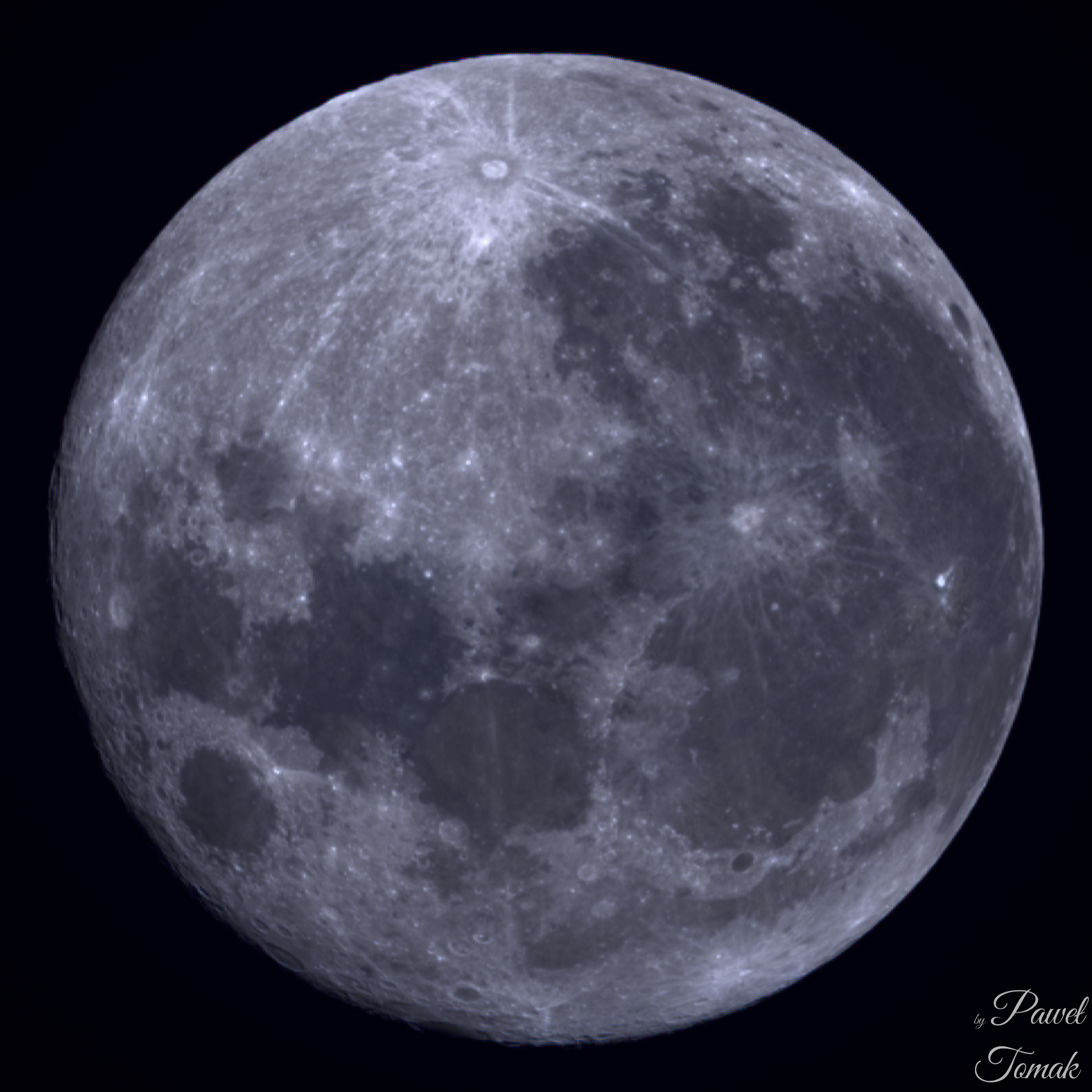
The Pink Moon is the traditional name given to April’s full Moon in several North American almanacs. Despite the cheerful nickname, the lunar disc does not turn pink; the label is usually associated with the spring bloom of pink phlox. Under full illumination the lunar surface shows strong albedo contrasts and prominent ray systems (for example around Tycho and Copernicus), while the lack of grazing light greatly reduces shadow relief near the terminator.
As a visual target the full Moon is straightforward and rewarding: it is bright, visible all night, and requires no dark site. Atmospheric turbulence is often the limiting factor, so the best results come when the Moon is high above the horizon. From a Bortle 5 location sky brightness has little impact on lunar imaging compared to deep‑sky work.
For this session on 2026‑04‑01 at 23:00 CEST, a SkyWatcher 150/750P Newtonian on a ZWO AM3N mount and a ZWO ASI2600MC Pro camera were used together with a SvBony Moon 2" filter. Short exposures and a high frame count were chosen to freeze the seeing; the best 10% of 475 frames were stacked in AutoStakkert!4 and gently sharpened and colour‑balanced in Siril to recover fine detail.
| SkyWatcher 150/750P | |
| ZWO AM3N | |
| ZWO ASI2600MC Pro | |
| SvBony Moon 2" | |
| Best 10% of 475 frames (≈48) | |
| 5 | |
| Full Moon (100.0%) — Pink Moon | |
| AutoStakkert!4, Siril |