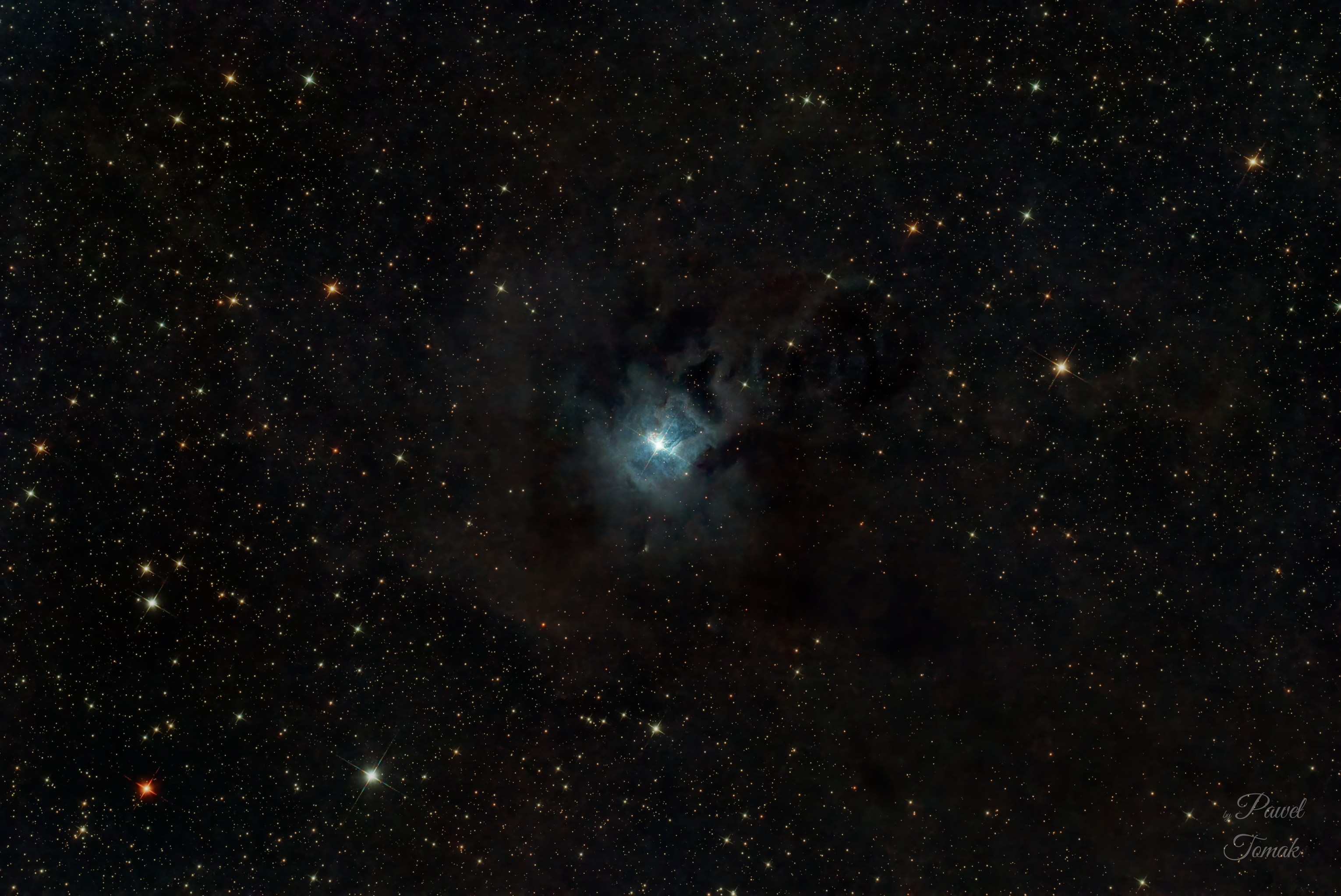
NGC 7023, better known as the Iris Nebula, is a bright reflection nebula embedded in a vast complex of interstellar dust in the constellation Cepheus, roughly 1,300 light‑years away. Its characteristic blue hue comes from starlight scattered by fine dust grains surrounding the illuminating star HD 200775, a young Herbig Be star. The bright central bloom spans a good fraction of a degree when including the surrounding dusty filaments, while the most prominent core measures only several arcminutes across, framed by sweeping, dark lanes.
The nebula was discovered by William Herschel in 1794 and is catalogued as Caldwell 4 in modern observing lists. From mid‑northern latitudes it is circumpolar, riding high in the northern sky and best placed during late summer and autumn nights, though it can be followed throughout the year. In binoculars under dark skies, the field is rich with faint dust; small telescopes reveal the bright core and the soft, fan‑shaped glow.
The Iris sits within an extended web of dust often referred to as galactic cirrus (IFN). Long exposures bring out intricate, filamentary structures and sharp, dark lanes silhouetted against the diffuse glow. The scene rewards deep broadband imaging and careful processing to balance the delicate reflection signal with surrounding faint dust.
| SkyWatcher 150/750P | |
| ZWO AM3N | |
| ZWO ASI2600MC Pro | |
| Optolong L-Pro 2" | |
| 50 × 180s (2h 30min) | |
| 5 | |
| Waning gibbous (81.0%) | |
| SetiAstro Suite Pro, Prism Deep, Axiom V2, Graxpert, CosmicClarity, Siril |