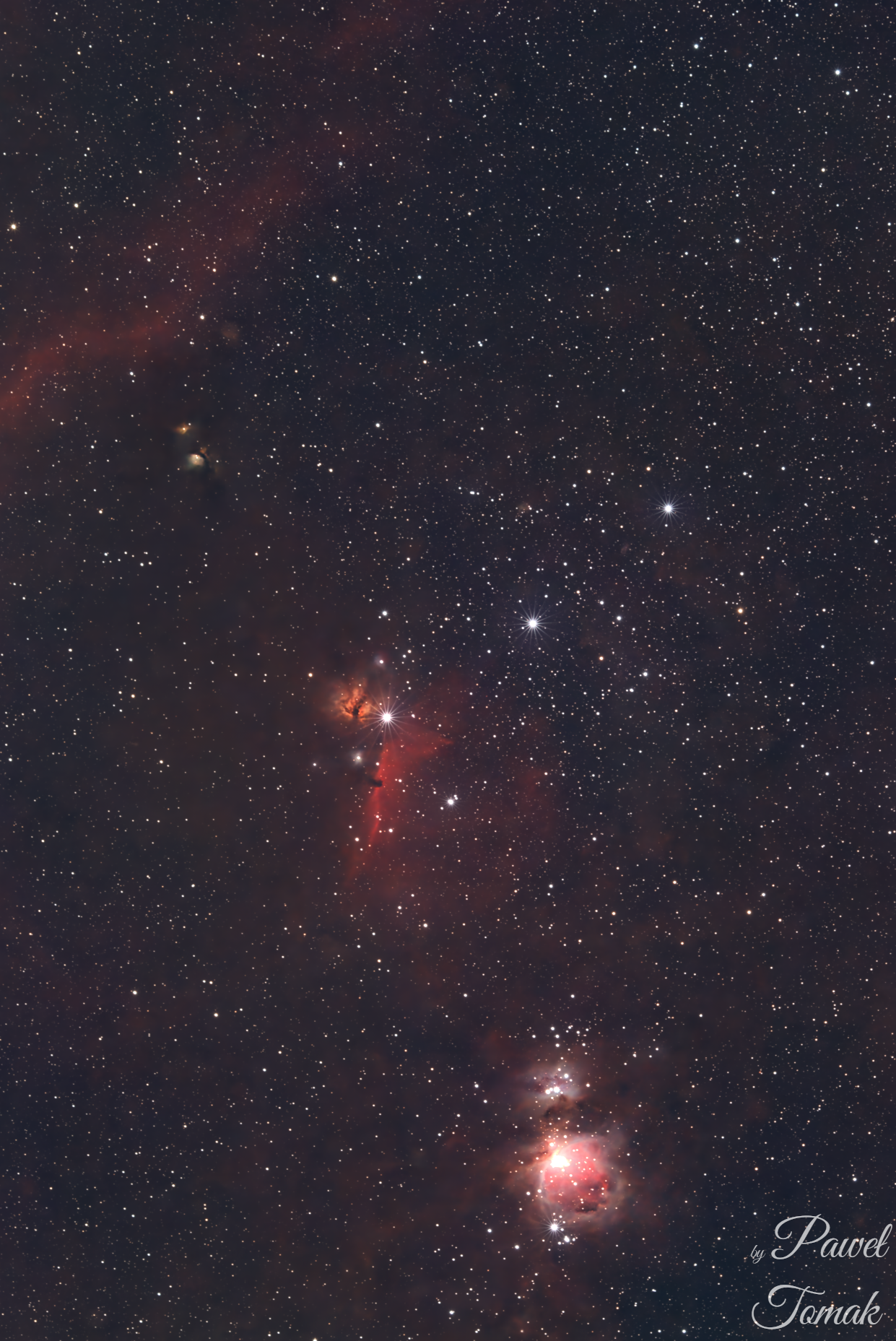
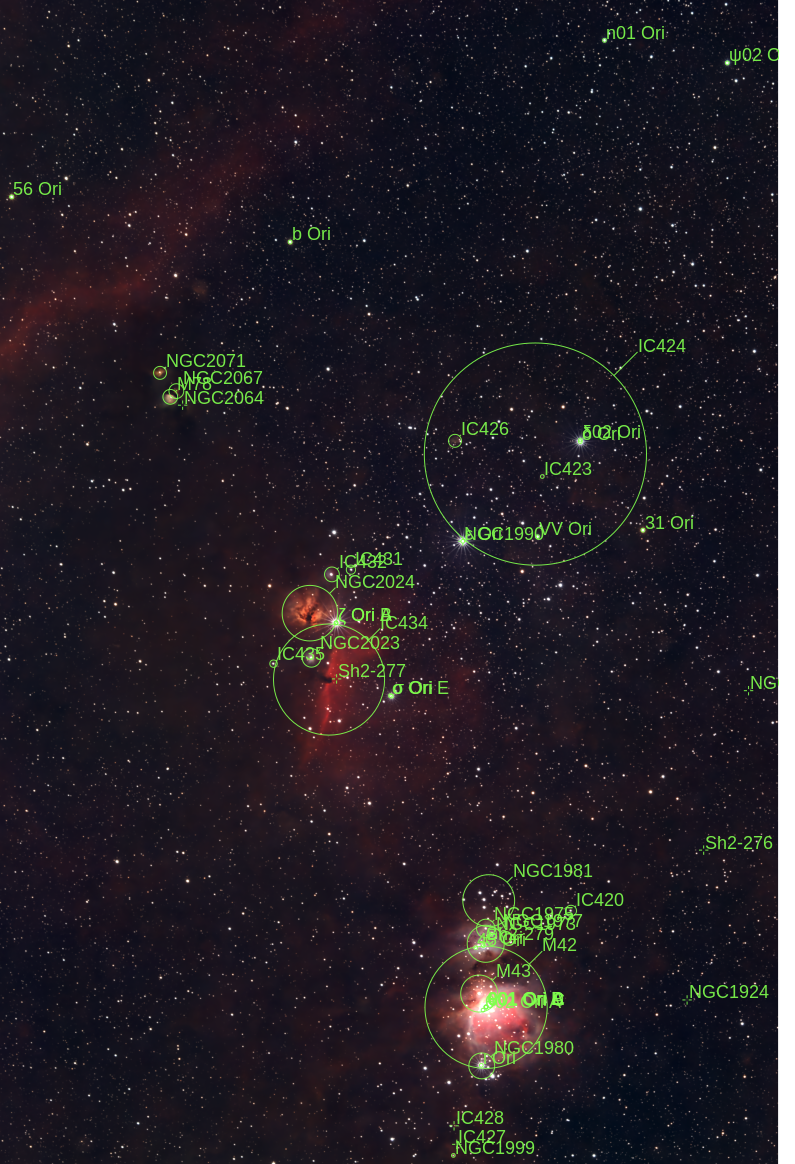
The constellation of Orion offers one of the richest wide‑field scenes in the winter sky. This image frames both the Belt (the bright asterism of Alnitak, Alnilam and Mintaka) and the Sword hanging below, with glowing hydrogen clouds and bluish reflection nebulae woven throughout the Orion Molecular Cloud Complex. Amid the Sword sits the famous Orion Nebula (M42), while to the east of the Belt star Alnitak stretches the red emission strip IC 434 with the dark Horsehead silhouette in front of it, and the compact reflection patch IC 435 nearby. The field is permeated by faint dust and H II regions sculpted by massive, young stars.
At the heart of the Sword, the Orion Nebula (M42) is a massive star‑forming region roughly 1,350 light‑years away, where the Trapezium cluster carves a bright cavity in the surrounding gas. North of M42 lies NGC 1977 (the “Running Man” reflection nebula), while much farther north‑east of the frame the giant Barnard’s Loop traces a faint arc of ionised hydrogen encircling Orion. The Belt itself is dominated by hot O‑ and B‑type stars; at its eastern end, Alnitak illuminates the dusty IC 434 Horsehead region together with the bright Flame Nebula (NGC 2024). IC 435, a small reflection nebula adjacent to Sigma Orionis, adds a cool, bluish contrast to the red glow of hydrogen.
The three Belt stars themselves are a study in extremes. Alnitak (ζ Ori) is a hot O‑type supergiant in a multiple system whose fierce ultraviolet radiation excites the Flame Nebula and the IC 434 emission layer; Alnilam (ε Ori) is a luminous blue supergiant whose powerful wind drapes nearby dust with a cool sheen; Mintaka (δ Ori) is a compact multiple of O‑ and B‑type components anchoring the Belt’s western end. Together they ionise and illuminate the intricate mixture of emission, reflection and dark nebulae that thread this field.
From mid‑northern latitudes Orion culminates high in the south between December and February, offering dark‑sky opportunities when weather allows. In binoculars the Belt and Sword are easily recognised, with M42 already distinct as a fuzzy core; small telescopes begin to resolve the Trapezium. Wide‑angle lenses and short telephotos (70–135 mm) excel at capturing the Belt‑and‑Sword composition, revealing the interplay between emission glow and reflection dust. Longer integrations under Bortle 5 skies help bring out the dimmer filaments and dark lanes that stitch the scene together.
| Canon 70–300 mm lens | |
| Motorised EQ3‑2 | |
| Canon 600D (astro‑mod) | |
| 81 × 61s (1h 22min) | |
| 5 | |
| Waxing crescent (3.1%) | |
| Siril, Prism Deep, Axiom v2 |