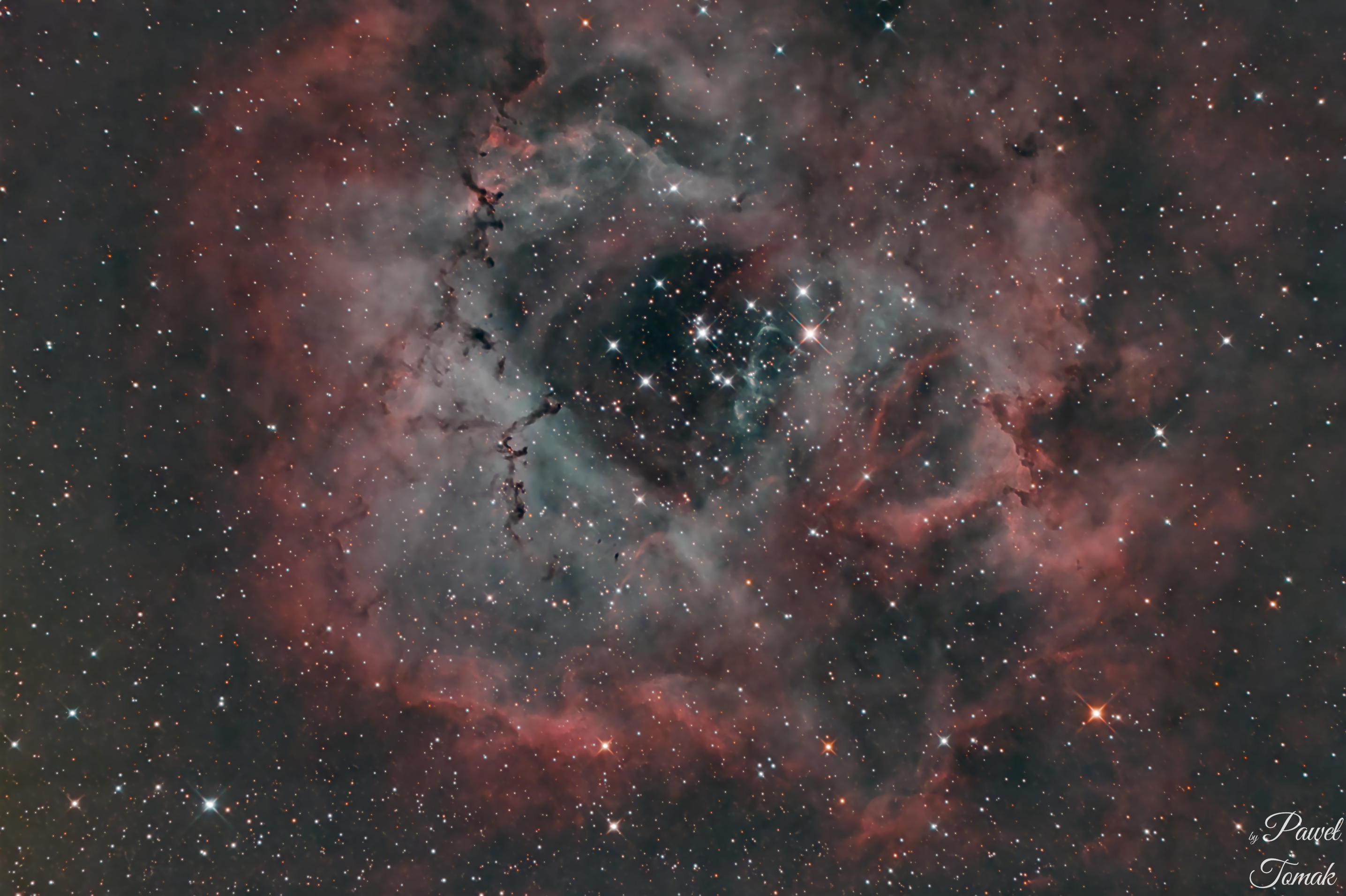
The Rosette Nebula (NGC 2237–2246) is a vast H II emission complex in Monoceros, roughly 5,200 light‑years away. Spanning about 1.3° on the sky—over two full Moons—its cavity and ring‑like envelope outline a star‑forming shell some 130 light‑years across, laced with dark dust lanes and bright hydrogen filaments.
At the heart of the nebula lies the young open cluster NGC 2244. Its hot O‑ and B‑type stars carve the central cavity with powerful stellar winds and intense ultraviolet radiation, sculpting pillars, globules and rippled fronts where new stars continue to form. The rosette‑shaped appearance emerges where the ionised gas meets surrounding molecular clouds.
Observationally, the Rosette is a classic wide‑field winter target for northern latitudes. It is best framed with short‑to‑medium focal lengths and benefits greatly from nebular filters. Visually, under Bortle 5 skies it is subtle, but imaging readily reveals the rich H‑alpha structure—especially with a mild‑band filter that boosts contrast even when some moonlight is present.
| SkyWatcher 150/750P | |
| ZWO AM3N | |
| ZWO ASI2600MC Pro | |
| Astronomik UHC 2" | |
| 172 × 60s (2h 52min) | |
| 5 | |
| Waxing crescent (0.5%) | |
| Siril, Prism Deep, Veralux, CosmicClarity, Darktable |