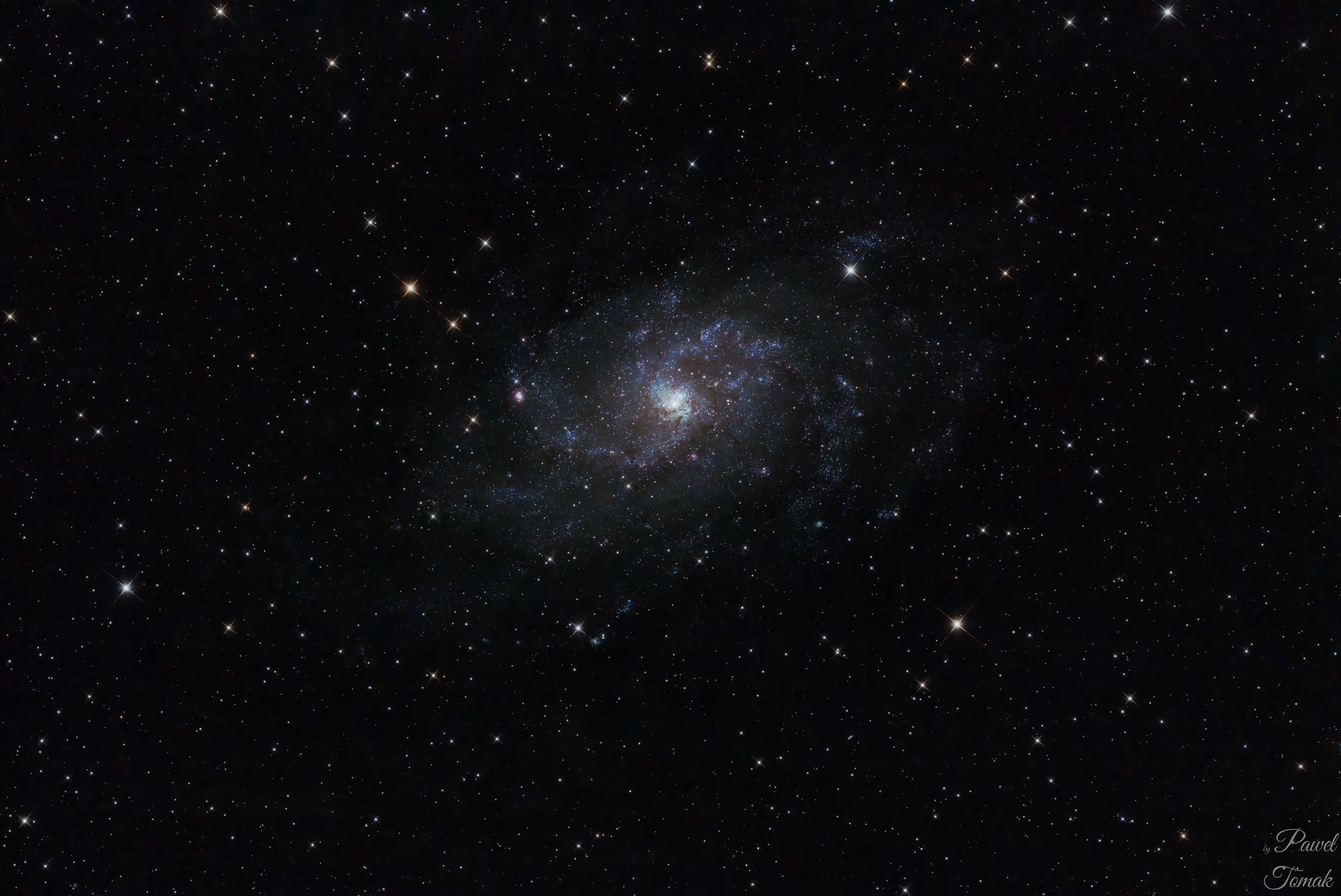
The Triangulum Galaxy (M33, NGC 598) is a face-on spiral galaxy in the constellation Triangulum and a prominent member of the Local Group. At roughly 2.7–2.8 million light‑years away, it spans about 60–70 thousand light‑years in diameter yet covers a large area on the sky—around 70 by 40 arcminutes—making it a rewarding wide‑field target. Its flocculent spiral arms are peppered with pinkish H II regions and blue star‑forming complexes.
Historically, M33 has been known since at least the 17th century (likely noted by Giovanni Battista Hodierna) and was firmly catalogued by Charles Messier in 1764. Under dark skies it can be glimpsed with the naked eye as a faint patch; in binoculars and small telescopes the galaxy shows a diffuse glow, gradually revealing structure as aperture and integration time increase. Autumn and early winter in the Northern Hemisphere provide the best elevation for detailed observation and imaging.
One of the most prominent features in M33 is NGC 604, a giant H II region among the largest in the Local Group. The galaxy’s relatively low inclination and rich star‑forming arms make it ideal for highlighting dust lanes, emission nebulae and clusters. M33’s dynamics and proximity to the Andromeda Galaxy (M31) are of continuing interest in understanding the evolution of galaxies within the Local Group.
| SkyWatcher 150/750P | |
| ZWO AM3N | |
| ZWO ASI2600MC Pro | |
| N/A | |
| 95 × 30s (47min 30s) | |
| 5 | |
| Waxing crescent (7.9%) | |
| SetiAstro Suite Pro, Prism Deep, Axiom V2, Graxpert, CosmicClarity, Siril |