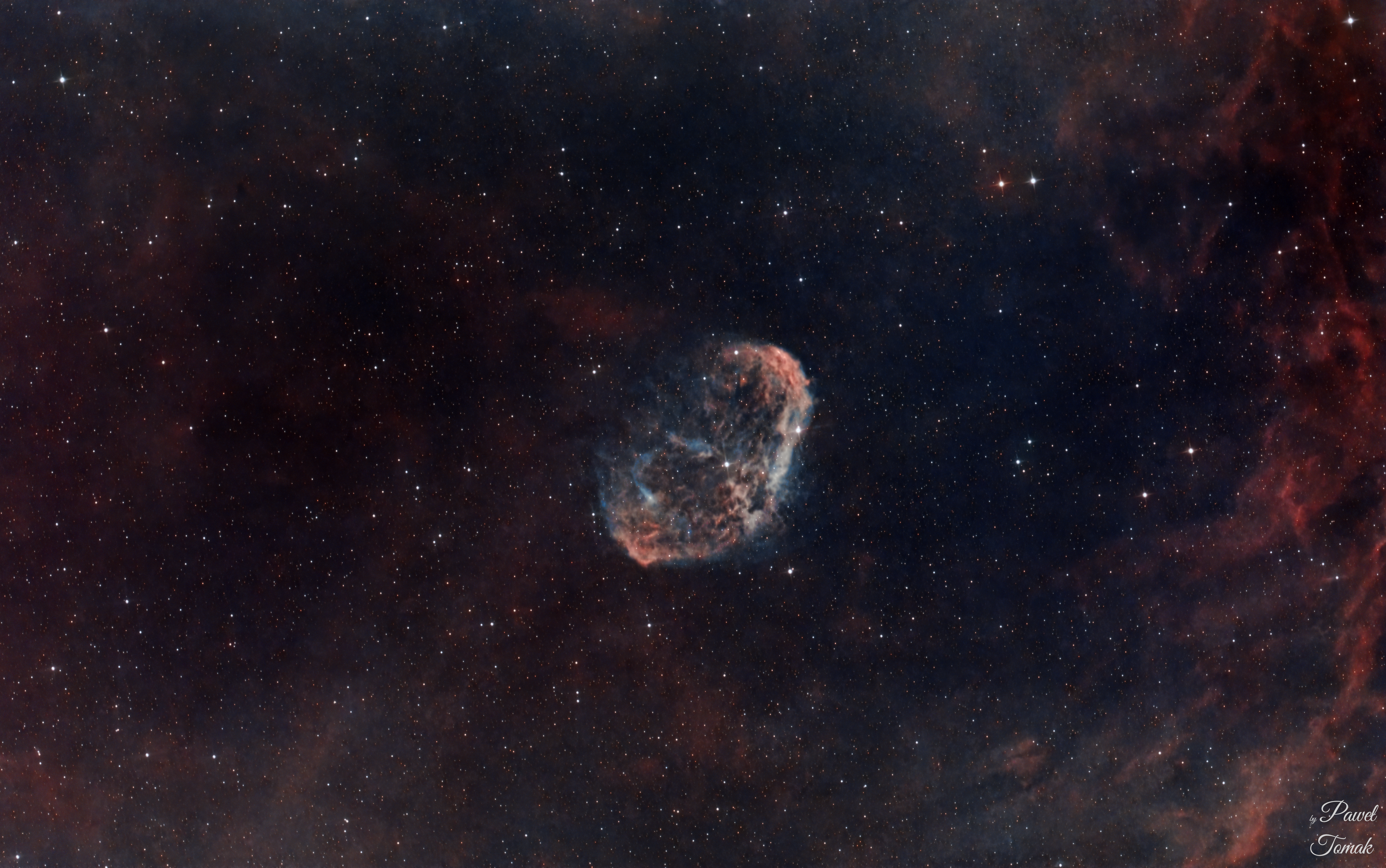
NGC 6888, known as the Crescent Nebula, is a wind‑blown bubble in the constellation Cygnus. It forms where the fast, energetic outflow from the Wolf–Rayet star WR 136 rams into slower material ejected earlier in the star’s life, piling up gas into shock fronts and glowing filaments. It lies about 4.7–5 thousand light‑years away and spans roughly 20 × 10 arcminutes (about 25 light‑years across), with bright oxygen‑rich rims and a fainter hydrogen shell.
Discovered by William Herschel in 1792, the nebula sits in the rich Milky Way starfields of the Northern summer sky. For visual observers it is a demanding target that benefits greatly from O III or UHC filters; small telescopes under dark skies can reveal the brightest arc as a delicate crescent.
For imaging, broadband cameras respond well with a UHC filter that suppresses light pollution and enhances emission lines. Longer integrations uncover the subtle web of filaments and the contrasting colours: teal O III arcs wrapping around reddish H‑alpha structures sculpted by intense stellar winds.
| SkyWatcher 150/750P | |
| motorised EQ3-2 | |
| Canon 600D (astro-mod) | |
| Astronomik UHC 2" | |
| 38 × 120 s + 78 × 120 s = 13,920 s (3 h 52 min) | |
| 5 | |
| Waning gibbous (94.8%) | |
| Siril, GraXpert, CosmicClarity, Gimp |