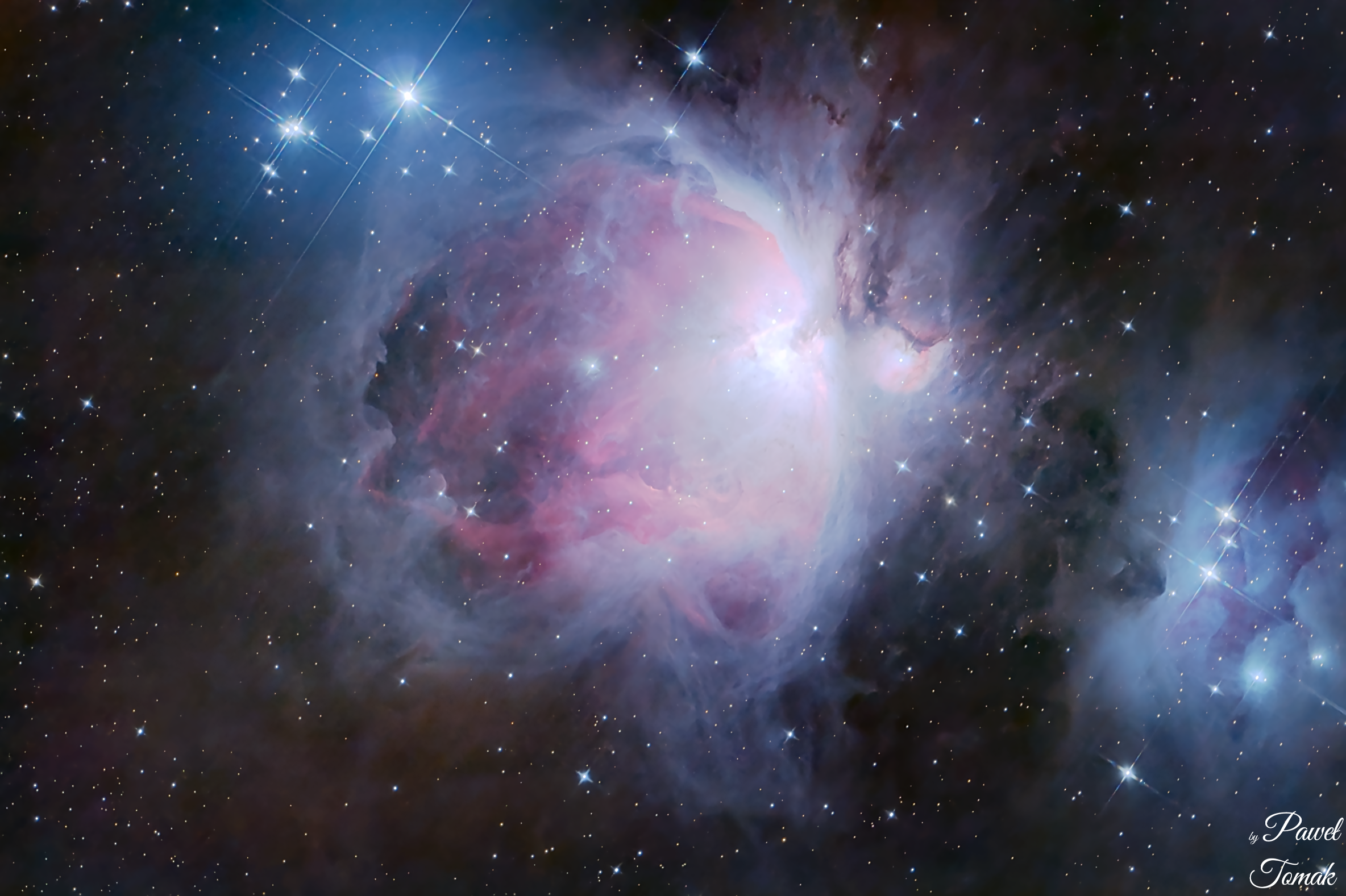
M42, the Orion Nebula, is one of the sky’s brightest and most photographed star‑forming regions. Located in the Sword of Orion about 1,350 light‑years away, it is a vast H II region where newborn, massive stars sculpt the surrounding gas and dust. In long exposures the nebula spans well over half a degree, with a luminous core fading into soft, wing‑like outer clouds.
At its heart lies the Trapezium, a compact group of hot O‑ and B‑type stars whose intense ultraviolet radiation ionises the nebula and makes it glow. Turbulent flows, shock fronts and dark lanes thread the scene; subtle colour differences trace different physical conditions — from pinkish hydrogen emission to bluish reflection from fine dust.
Visually, M42 is a rewarding target even from suburban skies. To the unaided eye under darker conditions it appears as a faint patch around the middle star of Orion’s Sword; standard binoculars already show a fan‑shaped glow. Small telescopes reveal the four main Trapezium stars and hints of texture; with increasing aperture and steady air the nebula’s curving wings and internal filaments become increasingly detailed. The best season to observe is the northern winter, when Orion rides high in the evening sky.
The Orion Nebula is embedded in a much larger complex — the Orion Molecular Cloud. Just north lies M43, separated from M42 by a dark dust lane, and above that the reflection nebula NGC 1977 (the “Running Man”). On a grander scale, the luminous arcs of Barnard’s Loop sweep around the region, testifying to past episodes of massive star formation and feedback.
| SkyWatcher 150/750P | |
| motorised EQ3-2 | |
| Canon 600D (astro-mod) | |
| Astronomik UHC 2" | |
| 91 × 45s (1h 8min) | |
| 5 | |
| Waxing gibbous (59.3%) | |
| Siril, Prism Deep, CosmicClarity, Gimp |