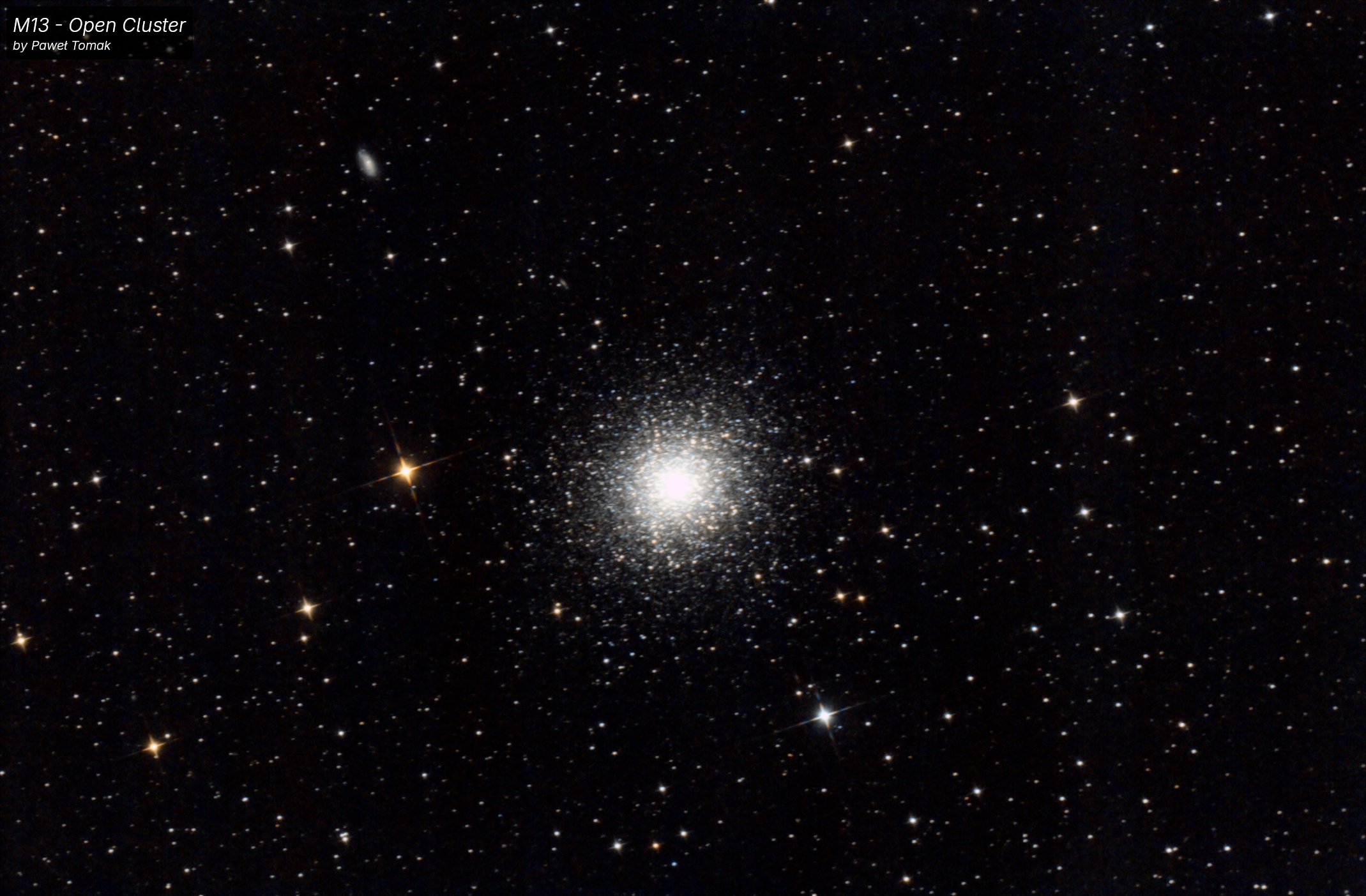
The Hercules Cluster (M13, NGC 6205) is one of the most famous globular clusters in the northern sky, located in the constellation Hercules. It lies about 22,000 light‑years from Earth and contains several hundred thousand very old stars, around 11–12 billion years in age. Under a dark sky it can be glimpsed with the naked eye as a faint, misty patch; binoculars reveal a grainy texture, and a small telescope resolves it into hundreds of tiny points. The cluster spans roughly 145 light‑years, with a dense, spherical core and increasingly diffuse outer regions where the stars are tightly bound by their shared gravity.
The Hercules Cluster also has a rich history of observation. It was noted by Edmond Halley in 1714, and Charles Messier added it to his catalogue in 1764. In 1974, the famous Arecibo message was beamed in its direction as a scientific experiment. The best time to observe it is in late spring and summer, when Hercules climbs high above the horizon. Even simple binoculars provide a satisfying view, while larger telescopes reveal subtle central structures sometimes described as dark “petals”.
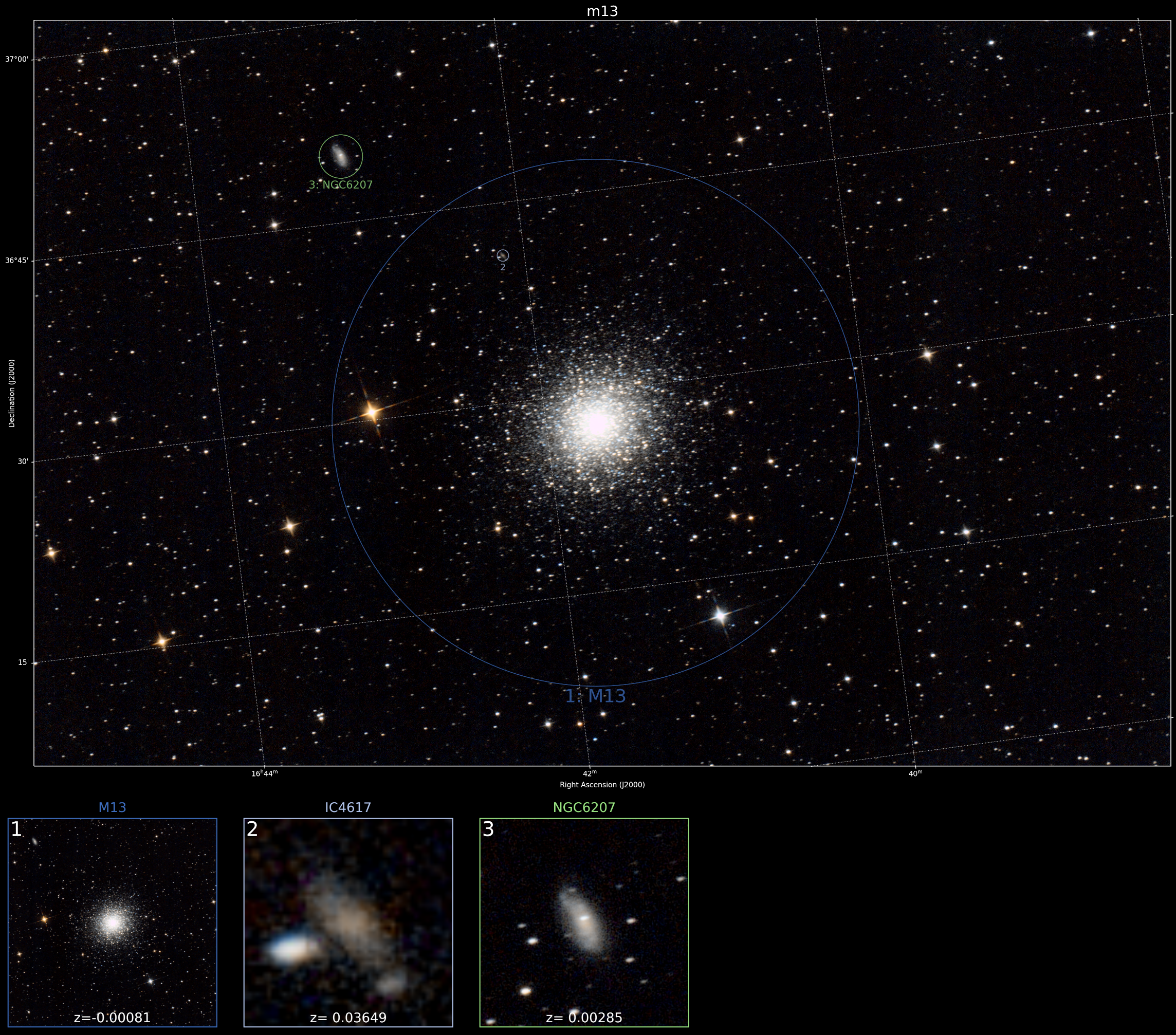
Besides M13, the image also shows two background galaxies. NGC 6207 is a relatively bright, small spiral galaxy near the cluster, tens of millions of light‑years away; in amateur telescopes it appears as a small, elongated smudge. IC 4617 is much fainter (around mag 15) and far more distant — a tiny, needle‑like galaxy mostly visible in longer exposures and larger instruments.
| SkyWatcher 150/750P | |
| motorised EQ3-2 | |
| Canon 600D (astro-mod) | |
| 56 × 180s (2h 48") | |
| 5 | |
| Waning gibbous (88.06%) |