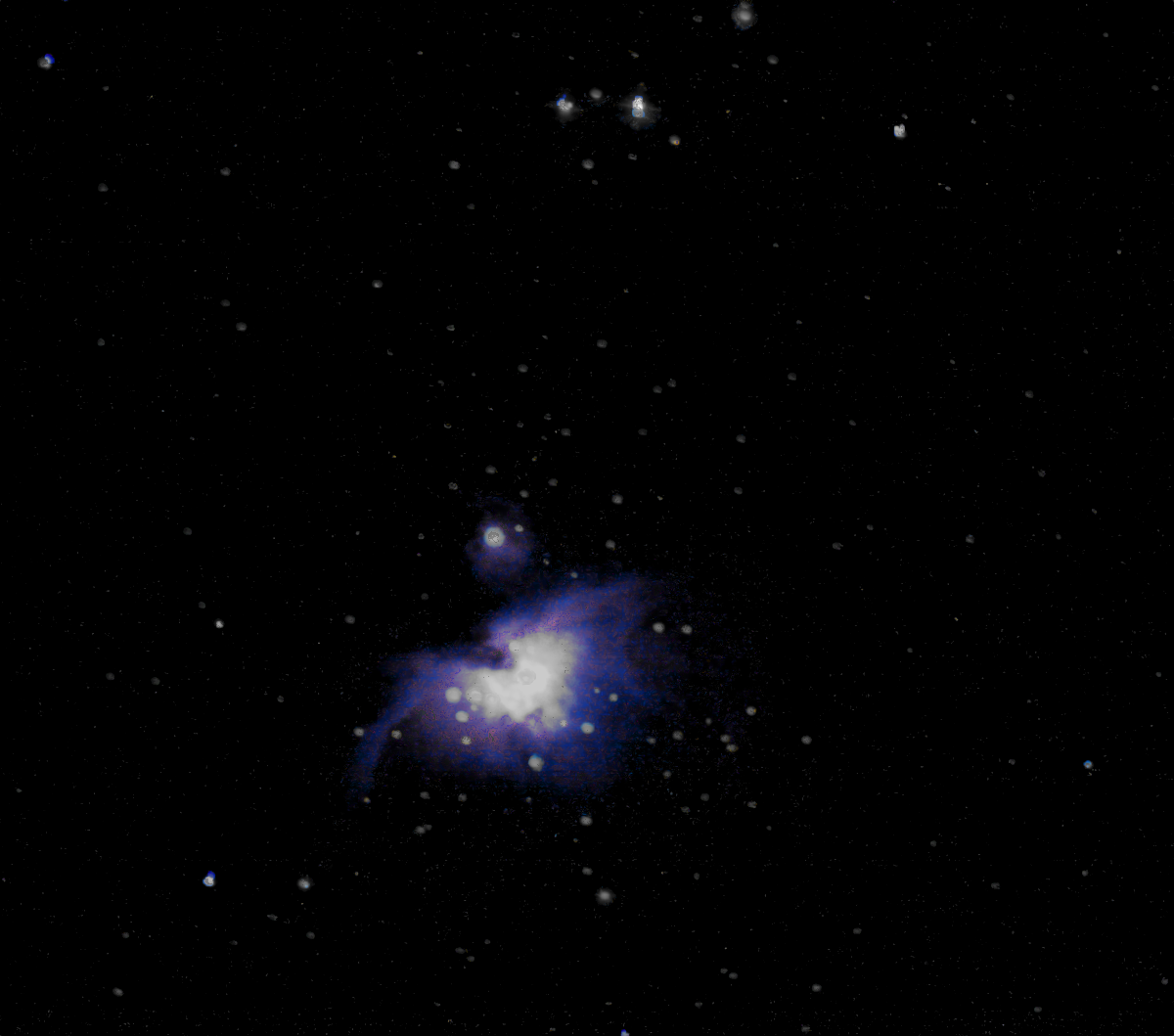
About my first astrophotograph
For my first post I decided to tell the story of my first astrophotograph. It all began a long time ago — at the turn of March and April 1997.
As a child, I went out with our dog for an evening walk. It was dark, the sky was cloudless. At one point I looked up and saw a strange object. I quickly realised it was a comet. As soon as I got back home, I grabbed my small pair of binoculars and ran back out to observe the phenomenon. A few days later I learned from the news that it was Comet Hale–Bopp, hailed as the Great Comet of 1997.
It was discovered on 23 July 1995, and in March 1997 it passed perihelion — the point of its orbit closest to the Sun. It was visible to the naked eye. It made a huge impression on me, but it still didn’t make me take up astronomy back then. I knew the basics — I could find Ursa Major and Ursa Minor, and the North Star — and I would sometimes try to catch the Perseids meteor shower.
Only in 2024, during the passage of Comet C/2023 A3 (Tsuchinshan–ATLAS), towards the end of its good visibility, did I decide to show it to my children — such an event doesn’t happen often. The childhood memory of Hale–Bopp came back, and that’s when I decided to buy a telescope to observe more of the cosmos around us. I did so on 17 October 2024. I chose a Sky‑Watcher Newtonian with a 150 mm aperture and a 750 mm focal length, one of the recommended beginner setups, on an EQ3‑2 equatorial mount. At first I managed to make several observations of the comet. November and December are a difficult time for astronomy in Poland — in 2025, throughout November and until mid‑December there were no clear nights.
The first deep‑sky photo came on 4 April 2025, after 21:00 — if I remember correctly. After a few visual observing sessions in January and February, I wanted to see whether, with the gear I had, I could take any sort of astrophoto. At that time of year the Orion Nebula (M42) sits fairly low, but it’s an easy target to locate, even with ordinary binoculars.
I used my old Canon 1000D DSLR. The mount wasn’t suited to astrophotography — for longer exposures you need a tracking drive to follow the apparent motion of the stars. Aware of the gear’s limitations, I recorded 60 frames at 1 s each so the stars wouldn’t trail. I processed them in the free programme Siril. The result? Perhaps not the best, but it’s a very important photo to me.